The Evals Replacement

Evals are not a guarantee.

A benchmark checks a handful of points and calls it safe. Melmac AI reconstructs the terrain underneath — classifying, routing, and controlling every model run in production, in real time, at every token.

$ stop burning tokens on dead ends
Melmac AI live run: a dead-end prediction fires, the run is killed, and it's rerouted to a cheaper model that can finish — with savings shown in real time.
live — a dead-end classified, killed, and rerouted before the waste compounds
Why Replace Evals

A benchmark tells you how a model performed on N tasks, once. It says nothing about the run happening right now.

Evals sample the map — a fixed set of points, drawn offline, revisited on a schedule if you're disciplined about it. Production is the terrain: every real run, every prompt drift, every model swap, continuously. By the time a quarterly eval catches a regression, thousands of runs have already burned budget on dead ends the benchmark never saw.

Melmac AI doesn't sample the terrain. It reconstructs it, continuously — then acts on what it sees before the waste compounds.

The Eval · Checked Once, Offline
“Summarize this 200-word support ticket in two sentences.”
✓ PASS · scored 96/100
Clean, single-issue ticket. This is the version that got benchmarked.
A Production Run · Minutes Later
A real ticket: three forwarded email threads, two unrelated issues, a signature block quoted twice.
✕ STUCK · re-summarizing the same paragraph on turn 4
Same task type the eval passed. Never checked. Never scored — until it was already burning tokens.
Points vs. Terrain

The same runs, read two ways: as isolated results, or as a map with a boundary on it.

The two panels below plot the same ten runs. On the left, they’re just results — pass, fail, pass, no pattern connecting them. On the right, Melmac AI draws the boundary between them, so the good zone and the risk zone are visible before the next run lands in one or the other.

Evals
10 points checked. No shape in between.
Melmac AI
Good Zone
Risk Zone
Same 10 runs. Now it’s a map.
The same behavior space — sampled at 50 points vs. reconstructed in full.
How It Works

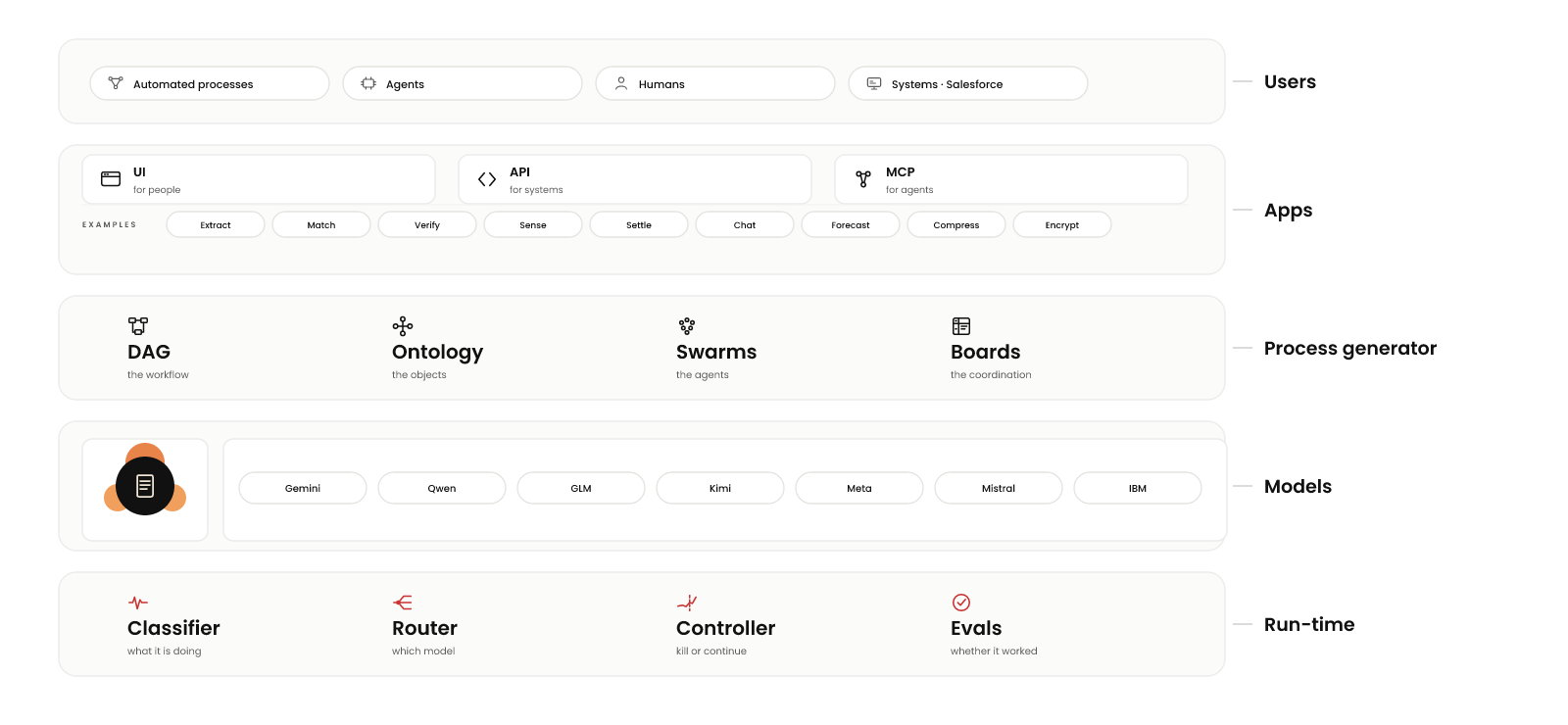
One live system, three jobs: Classifier → Router → Controller.

Not a dashboard you check after the fact. A control loop that sits in front of every model run and acts on it in real time.

01 · CLASSIFIER

Reads the terrain as it happens.

Observes the first 50 tokens of every model run and classifies its trajectory — will it succeed, stall, or hit its ceiling. An objective signal, generated continuously on live traffic, not a benchmark score computed offline against a fixed test set.

02 · ROUTER

Sends the run where it can finish.

The moment the classifier calls a run, the router hands it to the cheapest model that can actually complete the job — no manual model selection, no static routing table that's already stale.

03 · CONTROLLER

Owns the run, start to finish.

Kills dead-end runs before the waste compounds, reroutes automatically, and hands back either a finished job or a clean failure — never a silent burn nobody notices until the invoice.

The Evidence

This isn't hypothetical. This is a real agent run.

The Token Ceiling

$4.24 total. $2.84 of it after the score stopped moving.

Claude Opus 4.8. 53 turns. 22 minutes. The score hit 89 at $1.40 in — then the model kept running for $2.84 more, with zero further improvement. That's the default behavior of an agentic run with no mechanism to detect that the model has already hit a wall.

ceiling hit — $1.40 · score 89 · flat from here
classifier would have called it at token 50
Source: a16z — claude -p /goal Lighthouse score to 100, stop after 15 tries
A model dashboard showing efficiency, savings, and per-agent success rates and kills — the same waste, made visible as a live feed instead of a quarterly report.
The Market

Enterprise AI spend is up 10× in two years. A systematic 67% of it produces zero return, at every tier.

Source: Ramp AI Index (Aug 2026) · a16z research

$7,500/mo
per employee — top 1% of companies, today.
$660/mo
per employee — top 10%, mainstream adoption underway.
$12/mo
per employee — median enterprise, inflecting fast.

Replace your evals with a live system.

Early access available now. Stop burning tokens on dead ends.